
Access Osage County Probate Records
Osage County probate court records include estate administration cases, will filings, guardianship petitions, and conservatorship proceedings handled by the District Court in Pawhuska. This is the largest county in Oklahoma by land area. It sits within the Osage Nation reservation. Probate cases here can involve tribal land, federal jurisdiction, and headright interests, which makes some filings more involved than in other parts of the state. Records are available through OSCN online or in person at the courthouse on Grandview Avenue. The court clerk can help with case lookups and copy requests on weekdays. ODCR is another way to search if you want to check docket info from home before making a trip to the courthouse.
Osage County Overview
Osage County District Court
The Osage County District Court in Pawhuska handles all state probate proceedings for the county. This includes estate administration, will contests, guardianship cases, and conservatorship filings. The court clerk's office at 600 Grandview Ave. maintains all case records, dockets, and copies. Staff can assist with case lookups, certified copy requests, and general information about the probate filing process.
| Court | Osage County District Court |
|---|---|
| Address | 600 Grandview Ave., Pawhuska, OK 74056 |
| Phone | (918) 287-1000 |
| Hours | Monday-Friday, 8:00 AM - 4:30 PM |
| Judicial District | 10th Judicial District |
Osage County covers the entirety of the Osage Nation reservation, the only Indian reservation in Oklahoma that retained its original boundaries after Oklahoma statehood. Osage headrights, which are shares in the tribal mineral estate, are a unique type of asset that may appear in probate cases. The federal government and the Osage Nation both have jurisdiction over headright matters, which are handled separately from state probate.
If your case involves Osage headrights or restricted tribal land, you will likely need to work with both the Osage County District Court and the Bureau of Indian Affairs or Osage Nation offices in Pawhuska. The court clerk's office can point you in the right direction but cannot handle the federal or tribal portions of those cases.
Search Osage County Probate Records Online
Start with OSCN at oscn.net to search Osage County probate cases for free. Select "Osage" from the county dropdown and choose case type "PB." You can search by party name, case number, or attorney. A percent sign after a partial name works as a wildcard. The results include filing dates, party names, case status, and a full docket event list.
From the docket page, some documents are available to view or print directly. Others require a visit to the courthouse or a written mail request. For cases filed before electronic records were maintained, staff may need to retrieve paper files. If you are searching for older Osage County probate records, a phone call to the clerk's office before your visit is recommended.
The Osage County page on OklahomaCourtRecords.us provides a secondary court record search option. For land records tied to estates, the Osage County portal on OKCountyRecords.com lets you search deeds and recorded instruments by name or date range. Mineral deeds and oil lease assignments are common records in this county.
OKCountyRecords Osage County is particularly useful when tracking property and mineral interest transfers that occur as part of estate proceedings.
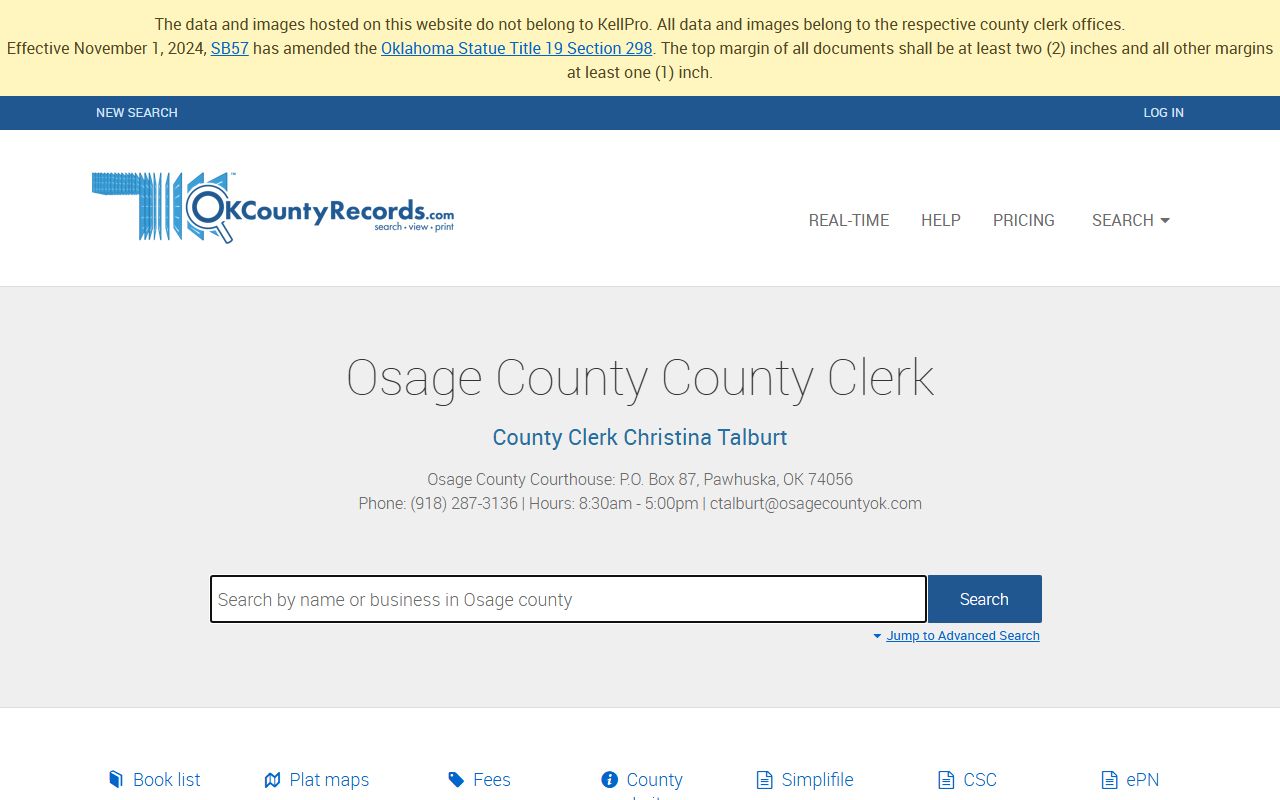
This screenshot shows the Osage County land records search interface on OKCountyRecords.com, helpful for connecting probate filings with recorded property and mineral transfers.
Note: OSCN case searches are free. Some documents require an in-person visit to Pawhuska or a paid ODCR.com subscription to access.
What Osage County Probate Records Contain
Probate records in Osage County cover the same core case types as other Oklahoma counties, with some additional complexity because of tribal land and headright interests. Standard estate cases include the petition, any will submitted for probate, the creditor notice and proof of publication, an asset inventory, accountings, and the final distribution decree. In Osage County, the inventory section of an estate file often includes mineral interests, oil leases, and grazing leases in addition to real property and financial accounts.
Intestate estate cases follow the same path but apply Oklahoma inheritance law to identify heirs. When the deceased was a member of the Osage Nation with headright interests, the state probate court handles the non-restricted assets while federal processes cover the headrights separately. Both proceedings may run at the same time, with coordination between the state court and federal agencies.
Guardianship and conservatorship records document court oversight for minors or adults who cannot manage their own affairs. These files include petitions, background reports, annual accountings, and court orders. Most of these records are public. Portions involving minor children may be restricted.
Wills deposited for safekeeping under 84 O.S. § 81 are held by the court clerk until the testator's death, at which point they become part of the public estate file when probate is opened.
Oklahoma Probate Process in Osage County
Probate in Osage County begins with filing a petition under 58 O.S. § 22 at the district court clerk's office in Pawhuska. The petition asks the court to open an estate and appoint a personal representative. Pay the $204.14 filing fee when you submit. The court sets a hearing date and reviews the petition for completeness.
The personal representative must publish a creditor notice under 58 O.S. § 241 in a local Osage County newspaper. The notice runs for two weeks, and creditors have two months from the first publication to file claims. After the creditor period closes, the personal representative files an inventory of all estate assets. In Osage County, this often requires separate appraisals for mineral interests, oil royalties, and grazing leases.
The court moves through a series of hearings before issuing a final decree. Standard estates typically close in six months to a year. Complex estates involving multiple types of property, contested claims, or coordination with federal processes for tribal assets may take longer. An attorney familiar with Oklahoma oil and gas probate matters is often a good idea in Osage County cases.
Smaller estates can use streamlined options. Under 58 O.S. § 331, an estate worth $50,000 or less can use a small estate affidavit with no court filing fee after a 10-day waiting period. For estates worth $200,000 or less, or when five or more years have passed since the death, 58 O.S. § 901 allows summary administration.
Osage County Probate Fees and Copies
Filing a probate petition in Osage County costs $204.14 for a standard estate case. Guardianship and conservatorship filings carry the same base fee. Relative guardianship petitions cost $67.00. These fees are paid to the court clerk at filing. Newspaper publication is an additional cost paid directly to the newspaper, typically running $100 to $200.
Copies of probate records cost $1.00 for the first page and $0.50 per additional page under 28 O.S. § 31. Certified copies carry an extra $0.50 per document. The rates are set by state law and are the same across all 77 Oklahoma counties. A search fee may apply if staff must locate a file without a case number.
You can request copies in person at the courthouse during business hours or by mail to the Osage County Court Clerk at 600 Grandview Ave., Pawhuska, OK 74056. Include the case number, party names, and filing year in your written request. Attach a check or money order made out to the Osage County Court Clerk. Staff will mail copies once the request is processed.
Probate Legal Help for Osage County Residents
Legal Aid Services of Oklahoma serves Osage County residents who qualify for free legal assistance. Call 1-888-534-5243 or visit legalaidok.org to apply. They assist with small estate affidavits, guardianship petitions, and general probate questions. For cases involving Osage headrights or restricted tribal land, you may also need to contact the Bureau of Indian Affairs or the Osage Nation's legal services. These entities handle the federal side of tribal estate matters.
For complex state probate cases, a private attorney with experience in Oklahoma oil and gas estates is recommended. The Oklahoma Bar Association's referral service can help you find one. Free standard court forms are available through the Administrative Office of the Courts at the AOC forms page on OSCN. These include petitions, inventory forms, and final accounting documents with filing instructions and statutory references.
Public Access to Osage County Probate Records
Oklahoma's Open Records Act at 51 O.S. § 24A.1 makes most Osage County probate court records public. Estate filings, will documents, inventories, and final decrees are available to anyone without needing to explain why they want access. The court may restrict portions of files involving minors or sealed exhibits, but the general rule favors public access. Federal probate records for headrights are held by the BIA, not the county court, and follow different access rules.
Osage County records go back to 1907. Because of the county's history with the Osage oil boom of the early 20th century, historical estate records here can be of significant genealogical and legal research value. The clerk's office has worked to preserve old records, and some early files are on microfilm. If you need records from the pre-1950s period, call ahead to check availability and retrieval time before making the trip to Pawhuska.
ODCR.com provides supplemental online access to Oklahoma court records. Basic searches are free. Document image access costs $5.00 per search for non-subscribers or $55 per month for a subscription. This is useful when OSCN does not show the specific document images you need.
Communities in Osage County
Osage County includes the county seat of Pawhuska and several communities including Hominy, Skiatook, Barnsdall, and Avant. Pawhuska is the headquarters of the Osage Nation tribal government as well. None of the communities in Osage County meet the population threshold for a dedicated city records page. All probate cases for the county are handled at the District Court in Pawhuska.
Nearby Counties
Osage County borders several Oklahoma counties and the state of Kansas to the north. Each Oklahoma county has its own district court for probate matters.